






You almost certainly haven't given your monofilament a second thought since the day you spooled up. That's rather the point of it. The less time it spends in the spotlight, the better. A few hundred metres of fine thread, thinner than the hair on your arm. It’s hard to imagine that behind it sits a fifty-metre production line, four decades of experience and hard-won judgement, and a man who doesn’t wear a top hat to work but based on what he does, could easily be mistaken for a magician.
"I enjoy what I do. Just to make something out of nothing."
So says Peter Glover, production manager at Platypus, the Queensland line maker collaborating with Alvey to produce the True Blue Monofilament. He started there at twenty. He's sixty now, which is a lot of time watching thread come off the rollers. He cut his teeth making trimmer cord and brush bristles. You were handed a specification, you hit it, and that was that. Fishing line was different.
“You could push the boundaries to try and improve the product,” he says. “We could play around all day just to make a stronger (or superior) line.”
MAKING LINES
Fishing line begins as raw pellets of nylon and copolymer blends, dosed with additives to soften it, stiffen it, or colour it, and then tumbled together in fifty-kilo batches. From there it goes into the extruder, a machine that mixes, heats and melts the resin and forces it through a disc shaped plate pierced with dozens of fine holes. It comes out molten and drops into a quench bath, and even the temperature of that water leaves its mark on the line's character.
Then the stretching starts, and this is where the strength is born. Rollers draw the line out of the bath and into the first drawing station. For every metre that goes in, three or four come out the other side. The line speeds up as it goes: twenty metres a minute at the first set of rollers, near a hundred and twenty by the third. Picture two dozen filaments flying through the air at that rate and the scale of this process begins to take shape. At the end comes an annealing oven that takes the tension back out. Without this step the line would shrink on the reel and damage a spool. A whisper of silicon goes on for the surface, and it winds onto the big bulk spools.
It doesn’t end there. Fresh line spends a fortnight drinking moisture out of the air until it softens. You can feel the difference between your fingers. The freshly made line is stiff, while the rested sample is limp and softer. Tackle Tactics made a great film about the process.
ZERO TOLERANCE FOR FAILURE
A counter-intuitive reality is that stretching line makes it stronger, right up until it doesn’t. “Stretching it to the point just before it breaks,” as Peter puts it. Go too far and the whole run lets go at speed. “It only takes one line to break,” he says, “and you could lose them all.” So you back it off, always, ever so slightly.
There’s another consideration: the line you've stretched hardest for raw strength could be weakest at the knot. Making one thing better might make another thing worse. Plenty of variables to juggle, but one constant is non-negotiable; consistency.
A customer might buy a three-hundred-metre spool, or a bulk spool with twenty thousand metres wound onto it. Peter can test the start and the end, but “Everything that happens in between those two ends is what counts,” he says. Two-hundredths of a millimetre is enough to shift the breaking strain, so every line is watched for diameter as it runs, because a change that small is a change that matters. “One weak point, and that could be the end of the whole lot.”
Line gives no notice when it’s weakened and fails at the worst possible moment; when it’s called upon to put in a full performance. The strike, the surge, the fish already on. As if that weren't enough, True Blue is built to break. An IGFA record line must break below its stated rating, or the record won't stand. The goal is as close beneath it as the maker dares, because every gram left unused is a fish lost to a rival. Under the ceiling, but never far under. A thread engineered to fail, precisely, on cue.
MORE ART THAN SCIENCE
At some point in every conversation about line the focus switches from the certainty of physics to the ineffable. Peter could make line stronger than anything out there, but he'd have to give up the knot to do it, and the stretch, and half of what makes a line pleasant to fish. Every property carries a cost paid in another. “It's easy to say we want everything,” he says, “but you can't.” Making great line requires knowing how to trade in virtues. “How one thing affects the next step,” is how Peter puts it. Forty years has earned him something a formula can't hand over: weighing the value of compromise and knowing when the price is right.
THE VANISHING
The disappearing act is another performance looking like magic while rooted in science. Nylon isn't truly invisible underwater. Fluorocarbon pulls that off, because its refractive index bends light almost the way water does. But it can be stiff and wiry with a lower knot strength, and you can't build a whole line out of it without losing everything else. So you make the line “as innocuous as possible” in the water. A blue hue fading out of sight without fanfare.
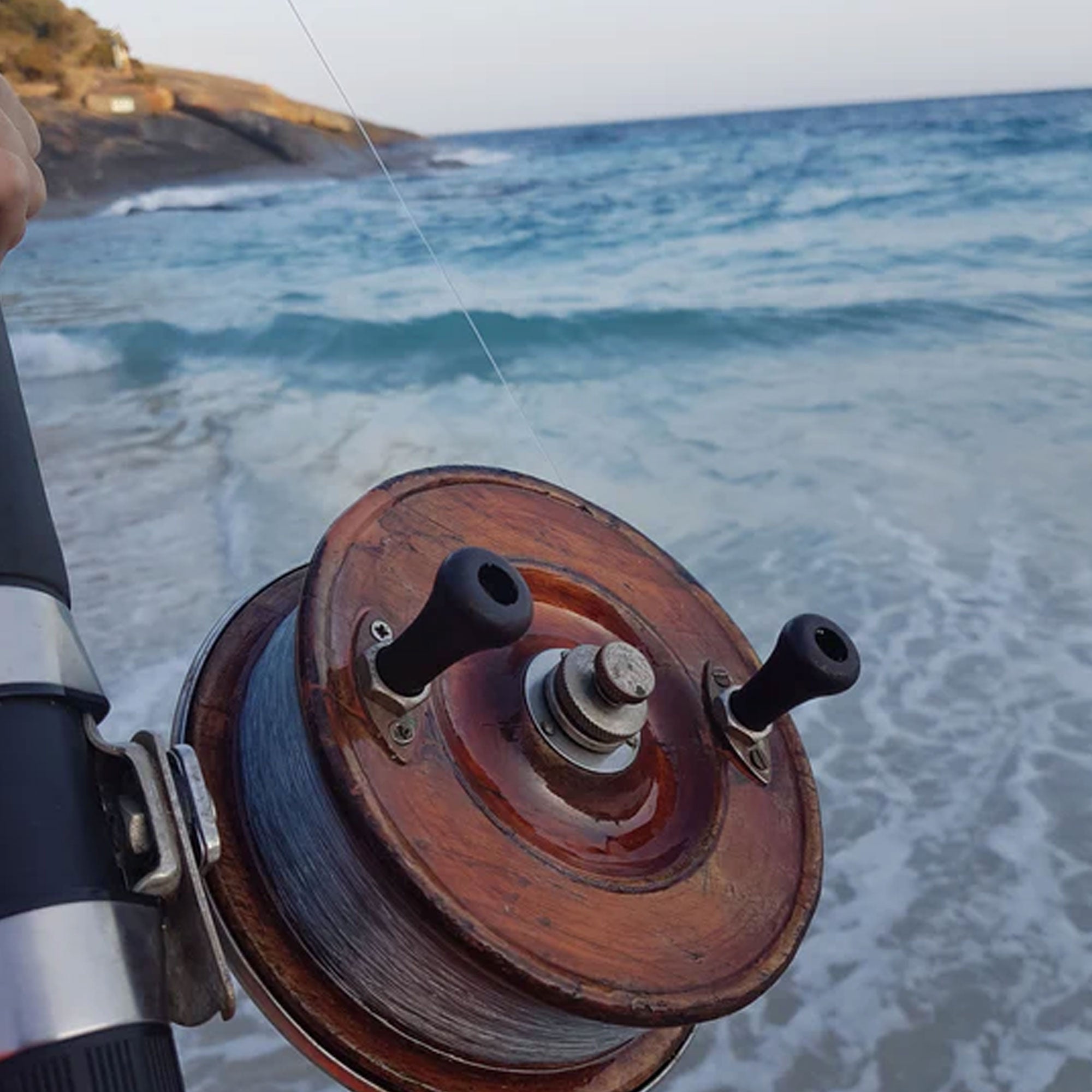
Being True Blue, mind you, it was only ever going to be one colour. “It had to be blue, didn't it?” he says, and you can hear the grin. The monofilament is a collaboration with Alvey, tuned for the surf and the long cast. Two Australian angling institutions working in tandem. “Just that Australian-made thing,” he says, “sticking together.”
THE KNOTTY PROBLEM
The maker owns the line. The angler owns the knot. For all that care upstream, most line failures occur at the business end. Tie a plain granny knot in braid and you throw away a third of its strength on the spot.
The solution is as simple as checking your knots every cast. A surf rig off an Alvey carries a heavy sinker flung as far as you can send it, which loads the knot the instant it goes; then it drags across rock and hauls up through sand on the retrieve. And sand, Peter notes drily, is precisely what the factory's abrasion tester uses to wear line to failure. It's basically glass, when you think about it. A quick look before each cast will reduce the chance of catastrophe. And keep it out of the sun. There are UV stabilisers at work but three months baking in sunlight will overcome them.
SILENCE IS GOLDEN
Ask Peter about the reward in what he does and he won’t talk about chemistry or machinery. He talks about what people do with it. Someone, somewhere, lands something massive on a line you can snap with your hands. “It's just crazy to think someone can possibly do that with something you've just made”. Platypus, by his own reckoning, sits in many entries in the record books.
The deepest satisfaction is much quieter than any record. It's the angler who spools up, fishes the line for years and never once picks up the phone. “The less you hear, the better,” Peter laughs, “The last thing we want to hear is a customer ringing up not totally happy with our product.”
The happiest angler is one so content he doesn’t even think to tell you. It’s taken for granted, and the trick that isn’t magic is complete; decades of experience, tons of machinery and weeks of production all to turn something… into nothing at all.
Shop the story
The line, the reel, the maker
Everything behind the disappearing act: the True Blue mono Peter Glover and his team build, the Alvey side-cast reel it was tuned for, and a spool of Platypus's own braid worth checking your knots on.


