
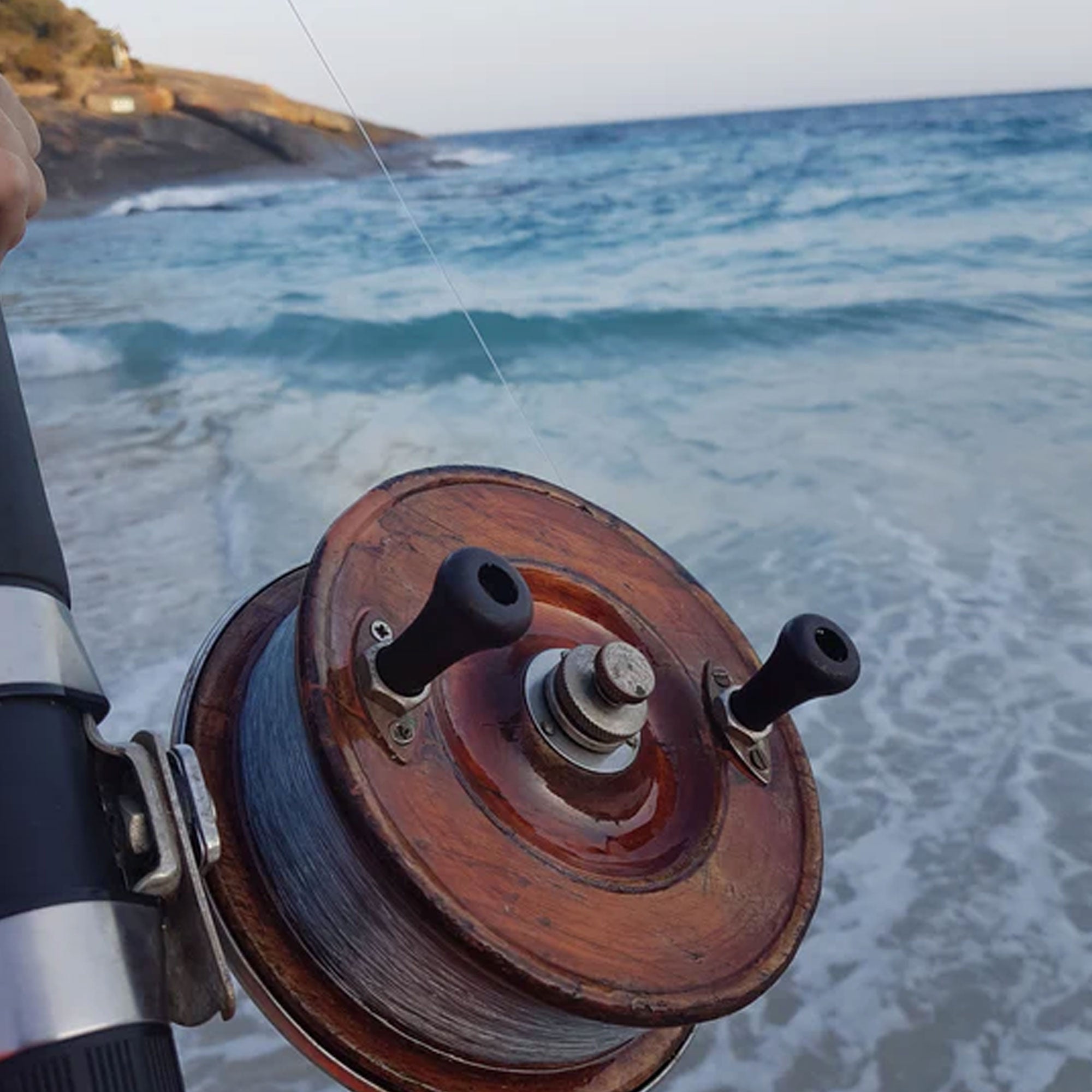





Anywhere you go outdoors, you're standing in more than one kind of time. It holds true for the sunset at the end of a long climb, the storm swell embracing the rocky point you've surfed for years, and a shifting stretch of coast you've fished since childhood.
The grass, the swell, the run of fish turn on the season. The slow grind of years are evident in the track wearing down, the dune creeping, the timber thickening. And the deep stuff below all of it; the rock, indifferent, older than any of us. We mostly pay attention to one or the other.
There's a hillside in southern Tasmania which invites you to see all three in a single glance. From the top of the paddock, a working dog balanced on the bonnet beside you, the grass gone silver-tawny with the season, the dam below reflecting the first hints of dawn, there's a moment just before the sun clears the ridge when Logie Farm shows you past, present and future all at once.
Sheep are scattered like spilled salt across the flats. It’s lambing season and they’re the morning's business. Along the water's edge, a ruled line of tree-guards marches off towards the dam wall. Green plastic sleeves, ankle-high, each one with a seedling inside it which will outlive anyone reading this. Blue in the distance, a hill that was old before the idea of a farm existed. Three clocks running at once; the season of the lamb, the generation of the tree and the epoch of stone.
Logie is a little over three hundred hectares of dry Coal River Valley country, half an hour north of Hobart, and it grew wool for the majority of its existence. What it does now is harder to summarise. The manager Lachlan Van Balen will tell you, his real job is not to impose.
“You let the environment tell you how it needs to be managed,” he says. The land talks. His work is to listen.

THE YEAR
The fastest clock is the one that won't wait. This country does not forgive a wasted rainfall. The averages are low to begin with, and what does fall arrives in winter and makes mud rather than grass. “The water in the Coal River Valley has the most extreme differences in dam levels I've ever seen in my life,” says Lachie, as he’s known to anyone who’s met him. The swing between plenty and bone-dry is one a manager has to read months ahead or pay for later. So the pastures have been rebuilt slowly towards perennials, lucerne mostly, which holds on through the summer pinch and is kinder to the soil than a crop torn out and resown every year. You work with what the ground will keep.
Hoggets grazed these lands in the past, raised for their fleece, the way nearly everyone here did it. This flock is a different animal: the Dorper, a hardy meat breed that suits a dry run. The prior stock manager, a man named Eddie, gave this ground thirty-one years and remains, in Lachie’s words, “a Merino man through and through”. Three decades of knowing exactly how one paddock behaves in a dry March is not a thing you can buy, so Lachie keeps him close, and notes when he speaks. His own father's hard-won insight in play: management is ninety per cent observation.
Somewhere between four and five hundred lambs drop in a season, and losses are a reality. “If you've got livestock, you've got deadstock,” he says, without flinching; losing as few as the percentages allow is the goal. The farm employs low-stress yards, two kinds of pain relief at marking, an autopsy after every death looking for ways to prevent others. This is the loop that closes. Take a lamb, and the flock makes another.

THE GENERATION
Then there's the hand you can see move, if you’re patient enough. The tree-guards along the dam are the near edge of something much larger and more important. Around thirty-five thousand native trees in fifty hectares of the property, most of them grown from seed collected on Logie itself. A new woodland sired by the remnants of a landscape cleared generations ago, raised to hold carbon and shelter wildlife. The dam they ring is part of a five-year Landcare program, fenced off from the stock and replanted so the water comes back cleaner and holds longer into the dry spells.
Olives stand on the northern slopes. Four thousand trees, the first commercial grove going into land that has only ever known sheep.
An olive is in no hurry. It won't hit full stride for years, and its productive life runs past a quarter-century. “There's a thirty-year project," Lachie says cheerfully.
A man in his thirties describing an undertaking that will peak when he is contemplating retirement. The slow tick repeats everywhere you look: the fencing, the soils, the breeding, a ruined stone cottage being lifted back course by course. “Once they're done, they're done for twenty years, thirty years.” The labour is front-loaded now, on purpose, so that someone later can “sit back and wait to harvest lambs and olives and carbon.”
Gowings opened its first store in 1868 and has spent more than 150 years thinking in generations rather than financial quarters. A firm that old can put in a grove the executive board won't live to see mature and treat that as ordinary business. Company and country, it turns out, keep the same kind of time. The legacy is a dividend paid to people you'll never meet. Nobody plants a shelterbelt for themselves.
THE EPOCH
And then, cut into the side of all this tending and planting, there is the take. Near the foot of the plateau sits a quarry. Blue metal comes out of it. Crushed dolerite, the same deep blue-grey stone as that conical hill. Dig down through the weathered red skin of the landscape into rock laid down in the Jurassic, dormant for millions of years, and truck it away to make roads. The past, enabling the future.
This hand only goes around once. A lamb replaces a lamb; a tree can spawn a forest. Nothing puts dolerite back.
It is the column in the ledger that will never balance. The quarry came with the place, “used and abused,” explains Lachie, and it took patient effort to coax it back into motion. Surveys and reports, silt traps and drains, a bond lodged for nature repair and, as early as they can manage it, trees planted into the pit itself, to hold the slopes and soften the scar. A stand of saplings doesn’t repay the withdrawal. Nevertheless, what you take from the deepest past, you replace as best you can. It’s a process closer to faith than accounting.

TICK TOCK
Come back to the top of the paddock, and a now empty coffee mug. A lamb an hour old, wet and finding its legs. A hill of stone here before anything had legs to find. Between them, a line of giants standing ankle-high in their plastic cribs. The sun clears the ridge. The dog drops off the bonnet. There's work to be done. Harvest what comes round again. Tend what renews. Plant what you'll never sit beneath.
Up on your own ridgeline, out back waiting on a set, or ankle deep in salty foam, the clocks are running there too. Pay attention and you can observe them all at once.
Shop the story
From Dawn To Dusk
The gear for your own first light in open country — the farm's own shirt, a hat for the horizon, boots for the paddock, and the mug for the coffee that gets you moving.


