



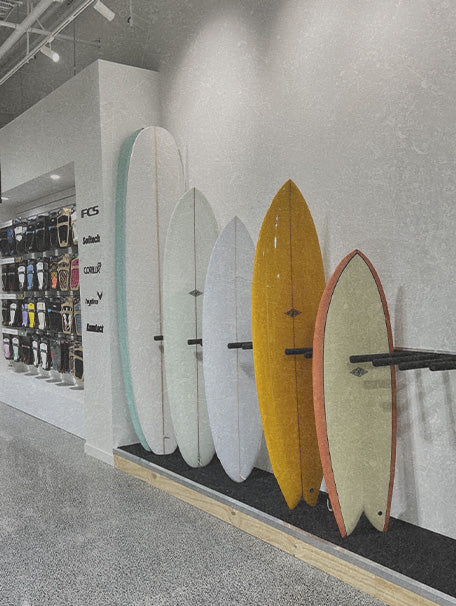



Your new thruster has arrived. It’s on the rack, alone. The rest of your quiver spreads across the floor as you contemplate which is getting the boot. One in, one out. That’s the rule. The obvious candidate is the single fin you bought when you couldn't yet tell a good board from a bad one. The wax is coated with dust. There's a terrible repair job near the tail you did yourself. Dents freckle the deck like random dimples on a golf ball. Not all of them are yours. This board was old long before you became the proud owner.
And now it’s taking up space you need. If you donate it to a beginner or sell it for a few bucks to offset the cost of the fresh stick, it might be riding waves again by the weekend. It was right for you when you needed its patience. A need you no longer have. No hard feelings.
CHANGE IS... GOOD?
The single fin wanted a commitment to a line. Thrusters want decisions. Lots of them. A pump for speed, a snap off the top, into the bottom turn and round again. Three fins hold where one never did, so you stopped worrying about losing grip and started asking the wave for more. By every measure you had, your surfing got better.
In 1981 a North Narrabeen surfer named Simon Anderson rode a three-fin board to wins at Bells, at home in the Surfabout, and at Pipe. By 1983, almost every short board had followed suit.
Decades later, your own path would feel less like a leap and more like natural progression. The single fin fell out of favour. You didn’t spare much thought on what might have gone with it. Pick it up now, though, hold it in front of you and something interesting happens. The board hasn't changed. You have. Time to see just how much.
OLD BOARDS, NEW LESSONS
The first wave you catch tells you everything you need to relearn. You pump for speed and nothing comes back. You lean on your back foot to swing it round and the tail slides. Writing about the impact of the thruster, Paul Gross said the arts of trimming and edge control “seemed to be lost”. One wave just spelled out how much you kept. The forecast for the next few days looks average. The new board deserves a debut in better conditions. For a session or two you'll surf noticeably worse on old faithful, and it'll feel like going backwards. Researchers Elizabeth and Robert Bjork spent decades explaining why. Change the conditions you practise in and you perform worse on the day, but you keep more of it afterwards. “Current performance,” they write, “is not a reliable index” of learning. The bad session is progression in action.
Rob Machado found the same thing on the far side of his competitive career. After the tour he rode single fins, twins and finless boards, and he credits them with changing his surfing. The boards, he told Surfer, “stretch your surfing out and force you to use more of the rail”. The first time you rode it, the old relic taught you to surf. You had nothing to compare it with. Now you do.
Every place the single fin fights you is a place where the thruster has carried the load, and the only way to fix that is to remove the scaffolding. The board first showed you how to surf. This time it shows you how you surf.
The change is more significant than you think. Psychologists at Harvard and the University of Virginia compared how much people said they'd changed with how much they expected to. At every age from 18 to 68, people believed they'd changed a lot but anticipated relatively little in the future. We keep thinking we're finished.
The surfer who put the single fin away was sure of it. The one taking it down is somebody else; a stranger this board has never met. No amount of “what if” creates space on the rack. Ideas bend. Maths won’t. One in, one out. The rack holds four and you own five. The question you're trying to answer might not be which board you’ve ridden least. It's whether you’d like to know what this board makes of the surfer you have become, and the lessons it might yet hold for the surfer you want to be.
Shop this story
Back in the water
Before the first wave puts you in your place: lay down a fresh coat, and redo that old repair properly.


